You spend hours creating content for your ecommerce brand. Your videos get thousands of views, your engagement metrics look great, and people are leaving positive comments.
But when you check your sales dashboard, the numbers tell a different story. People are watching, but they are not converting into buyers.
This is one of the most common frustrations for Shopify store owners. Consumers are entertained by your posts, but the journey from discovering a product to actually checking out is too complicated. Every extra click, redirect, or search step gives a potential customer a reason to abandon their purchase.
This is exactly what shoppable tags are designed to fix. They sit directly inside your content, meet the buyer at the moment of peak interest, and remove the friction that kills conversions. This guide covers everything you need to know about shoppable tags, how they work, where to use them, and how to get started on Shopify today.
What Are Shoppable Tags?
Shoppable tags are interactive icons placed directly over products within digital images or videos. When a user clicks or taps the tag, it reveals product details and provides a direct link to purchase the item. There is no redirect to a separate page, no searching through a bio link, and no hunting through a website menu.
These tags are a core part of modern e-commerce product tagging, where your content itself becomes a direct sales channel instead of just a marketing tool. The product is seen in context, tagged in place, and available to buy in one tap.
How Do Shoppable Tags Work in Ecommerce?
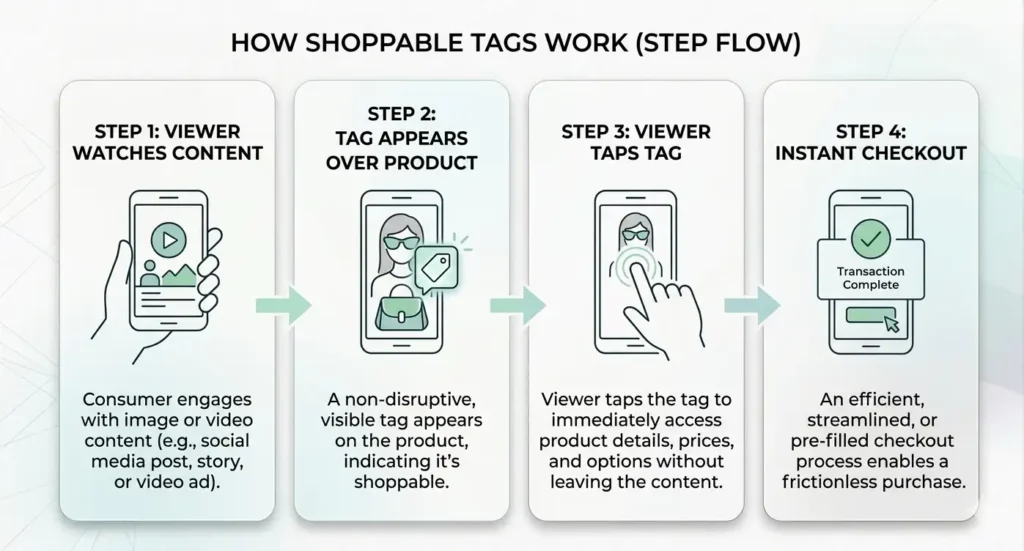
The interaction is designed to be completely frictionless. Here is exactly how it unfolds in practice.
A potential customer stops to watch your product tutorial or lifestyle video. As the product appears on screen, a small icon pops up directly over the item. The viewer taps the tag, instantly seeing the product name, price, and a checkout button. They can buy the item right there without ever leaving the content they were watching.
The entire experience happens within a single piece of content. There is no separate search, no navigating to a website, and no risk of losing the customer between the moment of inspiration and the moment of purchase.
Benefits of Shoppable Tags for Ecommerce Stores
Adding interactive shopping to your content is no longer an experiment. For brands that have implemented it well, the results are measurable and consistent.
Higher conversion rates at the moment of peak intent. Traditional ecommerce relies on a customer remembering what they saw, finding the link, searching the store, and completing checkout at some later point. Shoppable tags eliminate that delay. You capture the buyer exactly when their intent is highest because they are watching the product in use, in context, right now. According to Baymard Institute, the average documented cart abandonment rate online is just under 70 percent. A significant share of that abandonment happens because checkout involves too many steps. Shoppable tags directly address that root cause.
Reduced friction across the entire buyer journey. Traditional social selling requires a user to leave an app, open a browser, search your website, and find the specific item they saw in a video. Each of those steps is an opportunity to lose the sale. Product tagging removes those steps entirely. The customer stays in the content environment they were already enjoying, and buying requires nothing more than a tap.
Better experience on mobile. The majority of ecommerce browsing now happens on smartphones. Clicking small text links and navigating menus on a mobile browser is a poor experience. Shoppable tags are built for mobile users with large tappable hotspots that function smoothly on any touchscreen.
Shorter buyer journey without losing context. A shoppable video condenses the entire marketing funnel. Awareness, consideration, and conversion happen simultaneously within a single piece of content. This is particularly powerful for impulse categories like fashion, beauty, and home decor, where the visual appeal of a product in a lifestyle setting is a major driver of purchase decisions. Hence, companies are moving towards live commerce in this era.
Where Can You Use Shoppable Tags?
Instagram. You can tag products in feed posts, Stories, and Reels. When a user taps the shopping bag icon on a tagged post, they see product details and a purchase link. Instagram Shopping works particularly well for fashion, beauty, and lifestyle categories where visual presentation drives desire.
TikTok. TikTok Shop allows merchants and creators to attach product tags directly to short-form videos. The platform’s algorithm-driven discovery means a well-tagged video can reach a targeted audience at significant scale without paid promotion.
Your Shopify store. Embedding a shoppable feed directly on your homepage or product pages brings the same experience to visitors who are already in a buying mindset. On-site shoppable feeds typically convert at a higher rate than social platforms because the visitor has already navigated to your store. Shoppable tools make it straightforward to embed tagged video content directly into any Shopify page without code.
Live commerce. You can pin specific product tags to the screen while demonstrating items in real time. Viewers can ask questions and tap tags to purchase while you are holding the product. Brands using live commerce consistently report higher conversion rates than pre-recorded content because real-time interaction removes hesitation and builds trust quickly.
How to Add Shoppable Tags on Shopify
Step 1: Upload your content. Choose the video or image you want to tag. The quality of the underlying content matters. Poorly lit or blurry footage will not drive purchases regardless of how well the tags are placed.
Step 2: Sync your product catalog. Connect your Shopify store so your inventory is available for tagging. Some apps syncs directly with your Shopify product catalog, meaning you can search by product name or SKU and link the item in seconds.
Step 3: Position the tag. Place the hotspot directly over the product. For video content, time the tag to appear when the product is the clear focus of the shot, not when it briefly passes through the background.
Step 4: Publish and monitor. Track which tags generate clicks and which convert to purchases. This data tells you which products work best in a shoppable format and guides your future content decisions.
Shoppable Tags vs. Traditional Product Links
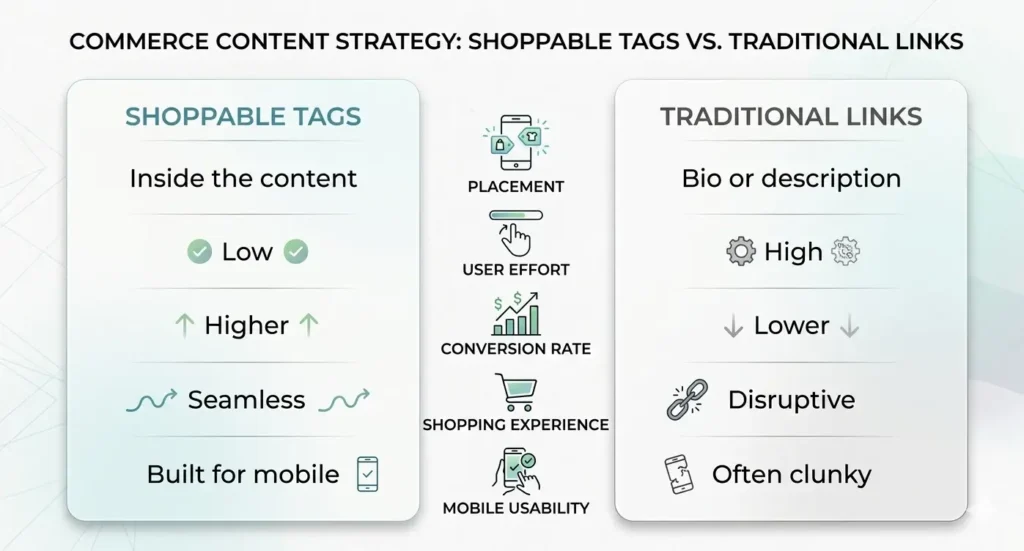
Traditional links live outside the content. They require the user to remember the product, seek out the link, and navigate away from what they were watching. By the time they reach your store, the impulse that drove their interest has often faded. Shoppable tags work at the opposite end of that journey, exactly where the interest was created, exactly when it was highest.
Types of Shoppable Tags
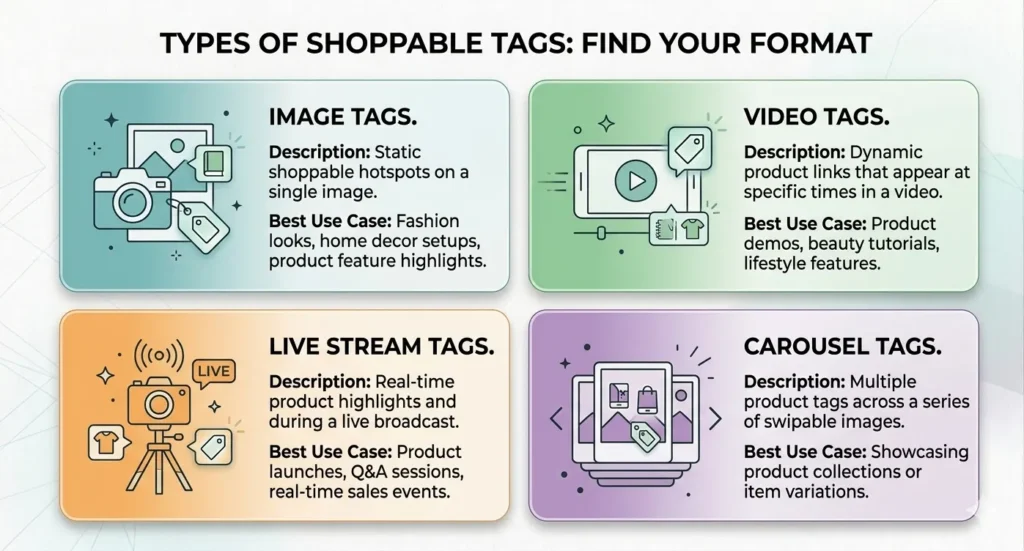
Image tags are the most common format. A static hotspot sits over a product in a photo. These work particularly well for lookbook style content and homepage banners where a single compelling image showcases a product in a desirable setting.
Video tags appear at a specific moment in a video as the product comes into focus. They can be timed to appear for a defined window, then disappear to keep the viewing experience clean. This is the most effective format for impulse purchases because the product is shown in motion, in context, and in use.
Live stream tags are pinned to the screen during a broadcast and can be updated in real time as the host moves between products. These create urgency because the opportunity to ask questions and buy a featured item is limited to the duration of the stream.
Carousel and product feed tags allow a single piece of content to feature multiple tagged products. A lifestyle video featuring a complete outfit can carry separate tags for each item, allowing the viewer to buy the full look or pick individual pieces, which directly increases average order value.
Best Practices for Using Shoppable Tags
Do not over-tag. Tagging every product visible in a video creates visual clutter and feels promotional rather than helpful. Focus on one or two key products per post. If you are shooting a lifestyle scene with multiple products, give the hero item the spotlight.
Time tags to the right moment. In video content, the tag should appear exactly when the product is the main focus of the shot. Wait for the close-up, the demonstration, or the detail shot. That is when purchase intent is highest.
Use high-quality visuals. A tag on low-resolution or poorly lit content will not convert. The visual quality of the content is the primary driver of desire. The tag is the mechanism for converting that desire into a sale. If the content is not compelling on its own, the tag cannot fix it.
Match the tag to user intent. A fast-paced entertainment clip calls for a fast checkout experience. A detailed product tutorial calls for a link to a full product page with reviews and specifications. Design the post-click experience based on what the viewer is looking for in that specific moment.
Common Mistakes to Avoid
Poor tag placement is the most common issue. A hotspot positioned near the edge of the screen or over text will frustrate users and generate low click rates. The tag needs to be centred on the product and easy to tap with a thumb on a mobile screen.
Slow-loading product pages kill conversions. If a viewer taps a tag and your Shopify page takes several seconds to load, they will bounce before it finishes. Page speed is not optional in a shoppable content strategy.
Not testing on mobile before publishing is a surprisingly common mistake. Content may look perfectly tagged on a desktop dashboard but have misaligned hotspots on a phone screen. Always preview on a mobile device before going live.
The Future of Shoppable Tags
The direction of travel is toward less friction, more automation, and deeper integration between content and commerce.
AI-driven tagging is already emerging as the next significant development. Rather than manually positioning a hotspot on each product in each video, AI models are beginning to recognise products in footage automatically and suggest or apply tags without manual input. For brands producing high volumes of content, this removes the most time-consuming part of the shoppable workflow entirely.
In-video checkout is moving from an experimental feature to a mainstream expectation. Rather than tapping a tag to view a product page and then completing a separate checkout, the entire transaction will happen without the viewer leaving the video. TikTok Shop is already the closest working example of this at scale.
Live commerce is likely to be the fastest-growing application of shoppable tags over the next two to three years. Markets like China, where live commerce already accounts for a substantial share of total ecommerce revenue, demonstrate what the ceiling looks like for this format in Western markets. Brands building the content habits and technical infrastructure for live shopping now will have a meaningful head start.
Frequently Asked Questions
What are shoppable tags? Shoppable tags are interactive, clickable icons placed over products in digital images or videos. When tapped, they display product information and a direct path to purchase without the viewer leaving the content.
Do shoppable tags increase sales? Yes. They increase sales by capturing purchase intent at its highest point and removing the steps between seeing a product and buying it. Instead of requiring the customer to search after seeing a product, shoppable tags make it available to buy in the same moment the desire is created.
Can I use shoppable tags on Shopify? Yes. Tools allow you to embed shoppable tagged video content directly onto your Shopify store pages without coding.
Are shoppable tags available on TikTok? Yes. TikTok Shop allows merchants and creators to attach product tags to videos, enabling purchases within the app.
What is the difference between shoppable tags and a shoppable feed? Shoppable tags are the individual interactive hotspots placed on specific products within a piece of content. A shoppable feed is the broader collection of tagged content displayed together, usually on a homepage or product page, allowing visitors to browse and buy across multiple posts at once.
Turn Your Content Into a Revenue Engine
Your content is already doing the hard work of capturing attention. Shoppable tags make sure that attention converts into revenue instead of evaporating the moment the video ends.
The shift toward interactive shoppable content is not a trend that will pass. It is the direction the entire ecommerce industry is moving, and the brands building these habits now will have the advantage when it becomes the baseline expectation.